

Sir Charles Gairdner Hospital bronchoscopy robot reaches 100 patient milestone
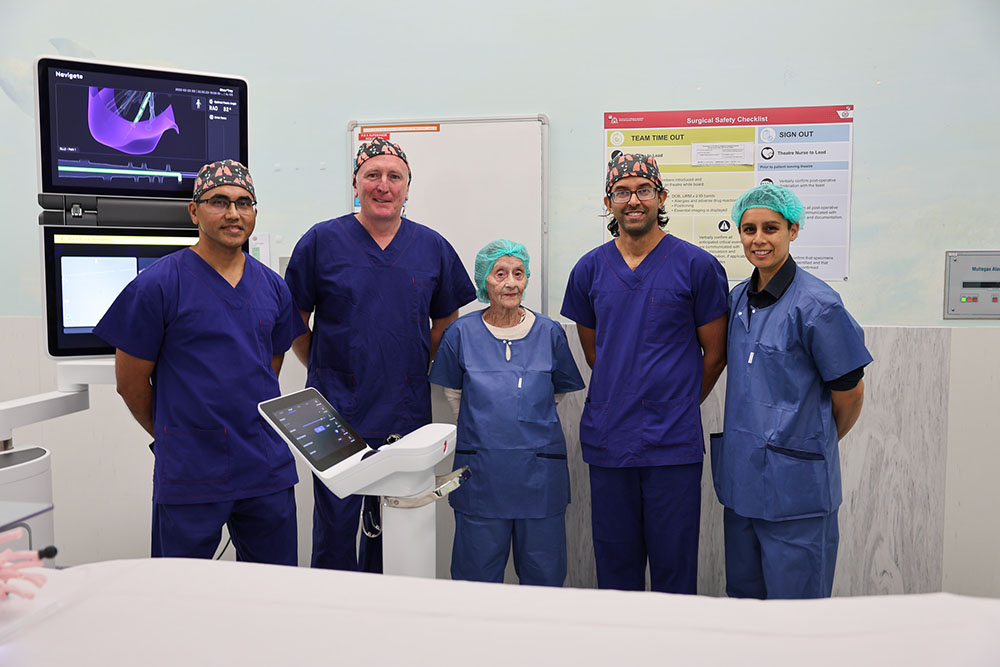 From left to right, Professor Rajesh Thomas, Minister Stephen Dawson, Sandra Ditmanis, Dr Dhaval Thakker, Sir Charles Charles Gairdner Osborne Park Health Care Group Acting Executive Director Renee de Prazer standing together in an operating theatre in Sir Charles Gairdner Hospital with the new bronchoscopy robot.
Sir Charles Gairdner Hospital (SCGH) has reached an impressive 100‑patient milestone with its new robotic bronchoscopy. This groundbreaking technology is helping clinicians diagnose and remove small cancerous nodules in the peripheral lung, where conventional biopsy tools face limitations.
Minister of Health for Medical Research, the Hon Stephen Dawson, visited SCGH to acknowledge the milestone and see firsthand the remarkable work of the teams involved.
"This Western Australian-first program has already benefited the lives of 100 people, and I congratulate and thank all those involved at Sir Charles Gairdner Hospital for driving the vision and delivering leading-edge patient outcomes," said Minister Dawson.
We also heard from patient Sandra, whose experience captured how the procedure's ability for earlier diagnosis and quicker treatment can make such a difference.
"I chose this option for my family. I wanted the least invasive approach possible so I could recover sooner. Knowing this was an option gave me real peace of mind," said Sandra.
Sir Charles Gairdner Osborne Park Health Care Group Acting Executive Director Renee de Prazer said the milestone reflects the dedication of our people to identify opportunities to provide high quality care, including the use of evolving technology and precision medicine.
This robotic technology is helping enhance early lung cancer diagnosis, reduce repeat procedures and improve diagnostic precision. Clinicians are able to go deeper into the lung to mark lesions with a glowing dye, guiding surgeons to more accurately remove cancerous nodules under a single anaesthetic event.
Professor Rajesh Thomas leads the Lung Cancer and Advanced Bronchoscopy Program at SCGH and led the establishment of the Robotic Bronchoscopy Service in WA.
He was awarded the FHRI Fund Enabling grant for the Robotic Bronchoscopy program last year and the FHRI-Raine Clinician Research Fellowship to optimise robotic bronchoscopy techniques to improve lung cancer diagnosis and treatment.
Lung cancer is the leading cause of cancer death in Australia, and it’s often diagnosed late because many people don’t notice symptoms until the cancer is advanced.
The robot has improved diagnosis of early lung cancer in patients by 50 per cent, pinpointing nodules as small as 4 millimetres.
A huge congratulations to all those involved, including our respiratory, surgical, nursing (bronchoscopy and theatre), anaesthesia, cytopathology teams, procurement, radiology and research teams.
The bronchoscopy robot equipment was made possible thanks to funding from the Future Health Research and Innovation Fund and generous donations by the McCusker Charitable Foundation, Charlies Foundation for Research and the Institute for Respiratory Health.
The National Lung Cancer Screening Program allows eligible Australians aged 50 to 70 years to have a low-dose CT scan every two years to detect signs of lung cancer.
For more information see: National Lung Cancer Screening Program (external site).